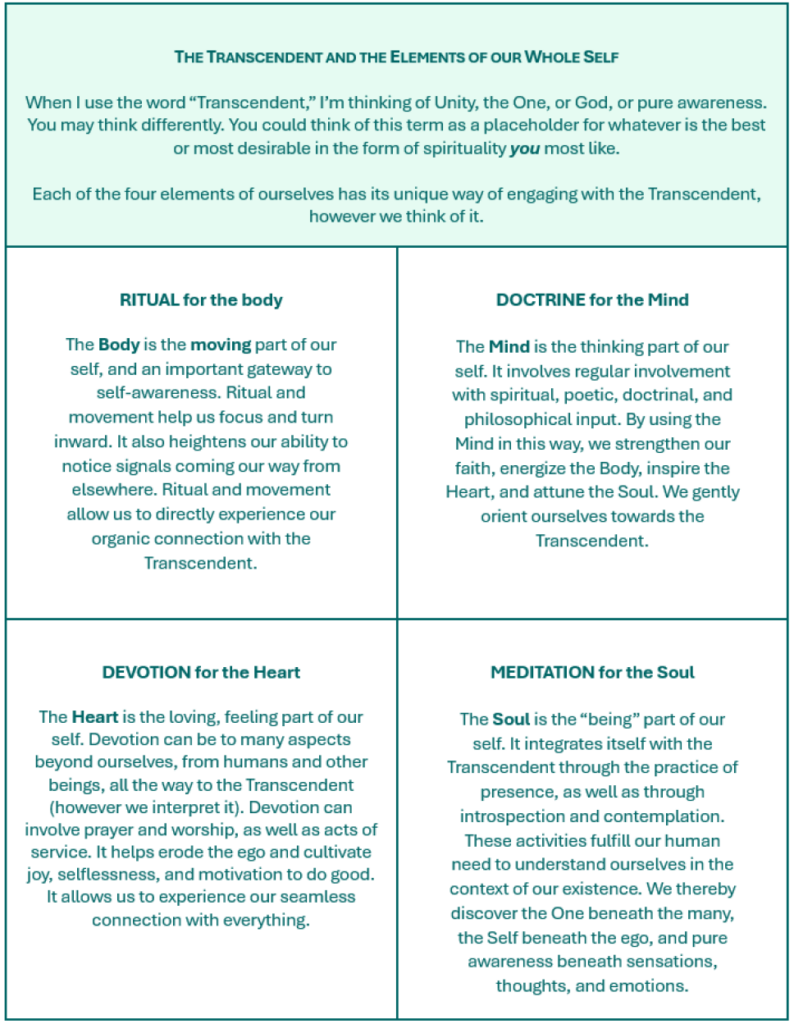
When I talk about the Unified Path, I usually emphasize the Four Elements: Body, Mind, Heart, and Soul. These are the four elements which, in harmony, create the whole of a human being—and each of these elements can be integrated into one’s spiritual or religious life to draw nearer to what I call “the Transcendent.” I often mention the “Transcendent.” It’s not really a common term, so I thought I would say more about it.
What actually is “The Transcendent?”
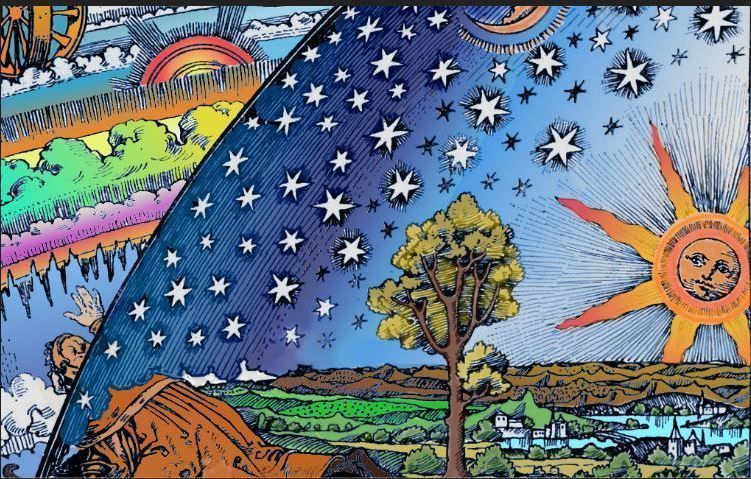
Usually, when I employ the word “Transcendent” when speaking about spirituality, I’m using the term as a broad placeholder for whatever you’d think of as the ultimate in the spiritual system you hold dear. It is usually something that our spiritual goals point to: something undivided, good, and that isn’t reducible to body or mind.
Whether we choose to refer to it as God, The Universe, Awareness, Energy, The Unlimited, The Transcendent, or even the Divine, it is that which exists beyond us.
Many people think of this ‘beyond’ as our initial source, an essential part of our true nature, and our ultimate goal.
For myself, I think of the Transcendent as the One, as God, Unity, or as pure Awareness. I’ll tend to use those terms here. But I recognise that many people have other ideas about what is spiritually highest. What I wish to communicate is a message about unifying our spiritual approach, using all the elements of our selves. In my experience, this “unified-path” approach applies across many forms of
spirituality. So when you see my own terms in what I share, please feel free to interpret according to your own understanding.
Because of our richness and complexity as human beings, we have different ways of approaching our connection with the Transcendent. It’s like how some people are visual learners, some are auditory learners, and some learn by doing.
As a provisional convenience, somewhat arbitrarily, I have come up with a way to talk about how we engage our spiritual lives. I talk about engaging through the Body, Mind, Heart, and Soul: the unified path.
The Body is the moving part of us. The Mind is the thinking and conceptual part. The Heart is the feeling, loving part. And the Soul is the “being” part. This is the part of us that experiences a direct, non-conceptual knowledge or unity with things, including the Transcendent.
For me, the idea behind the Unified Path is eminently practical. It’s this: when we engage all four elements of our selves, Body, Mind, Heart and Soul, we have the best chance of realizing our spiritual goals.
It’s true that by default, we already do use all four elements. But for each of us, it’s important that we don’t over-use any element, or under-use any. In my own life, there was a time when I discovered that I was over-using the Mind element, and under-using the Soul and the Heart elements. I made some changes and began adding a new direction. Very quickly, I began to feel more balanced in my spiritual life and in my life overall.
This is what the Unified Path is all about. It advocates that, whatever we are doing in our spiritual lives, do it in a balanced way that optimizes our strengths, while not neglecting any part of ourselves.
For each person, this optimal balance will be different. And it may differ over time even for the same person.
Here are some examples of how we use the four elements in our spirituality:
For the Body, we connect to the Transcendent through slowing our pace and finding or making meaning in our movements. Rituals are a key way by which we access meaning through motion.
As expressed previously on this page, rituals are repeatable, physical actions that increase concentration and interiorization. A ritual calls us to be present, as we notice sensory signals and recognize the limits, place, and context of our physical being. We experience our physical selves as directly connected to what lies beyond.
While rituals can be highly specific, as with the rituals of a Catholic mass or a Native American Tribal dance, they don’t have to be. The action of making a cup of coffee can become a ritual when we approach it mindfully.
For the Mind, we connect to the Transcendent through attention and intention. We can use the Mind’s learning and thinking abilities to help us towards our spiritual goal. Of course, the Mind also needs the help of its team-mates (the Body, Heart and Soul), but it too has a role to play.
How do we do this? Usually, by engaging with doctrine—that is, spiritual, philosophical, or religious content. Doing so points the mind towards the highest, and permeates our lives with whatever we hold as Transcendent.
For the Heart, we connect to the Transcendent through the practice of devotion. While devotion looks different in practice for everyone, it universally serves to erode the ego, moving the individual from a framework of selfishness to selflessness, from solitude to connection.
Simply, devotion engages the Heart in the love of the other—including humans and other beings, principles, ideas, and the love of the Transcendent. For some, this
may look like volunteering time at a hospital or soup kitchen. For others, devotion can mean showing up as our best selves in our relationships, communicating and acting with kindness.
The Soul is the “being” part of ourselves. It engages directly and
non-conceptually with what lies beyond ourselves. This includes the Transcendent and other aspects of Being. We experience directly that we are not separate from one another, nor are we separate from God or the Beyond. Recognizing this frees us.
Meditation and inquiry can lead us to such recognition. We can focus our inquiry on the One beneath the many, the Self beneath the ego, and pure awareness beneath perceptions, thoughts, and emotions.
Take a moment here to pause. Perhaps close your eyes.
Take this opportunity to reflect: When was the last time that you felt connected to The Transcendent? Where were you? What were you doing, or not doing?
How might you continue to develop your relationship with The Transcendent?